
MAGNANI-ROCCA FOUNDATION – MAMIANO DI TRAVERSETOLO (PARMA)
12 September 2026 – 13 December 2026
“I paint what cannot be photographed, what comes from the imagination, from dreams, or from an unconscious impulse. I photograph the things I do not wish to paint—things that already exist.” With these words, Man Ray summarized an entire philosophy of art in which the boundaries between disciplines vanished, and every medium of expression served a single, inexhaustible creative vision.
Man Ray: Tutto (Man Ray: Everything) is the most comprehensive retrospective ever dedicated to the artist in Italy, featuring over 300 works—including photographs, paintings, objects, sculptures, graphic works, books, and films. It runs from September 12 at the Villa dei Capolavori, home of the Magnani-Rocca Foundation, marking the fiftieth anniversary of Man Ray’s death in Paris on November 18, 1976.
Just a short walk away, in the permanent collection galleries, hang major works by Titian, Dürer, Van Dyck, Goya, Canova, Monet, de Chirico, Morandi, and many others. Among them are the rediscovered masterpieces by Renoir, Cézanne, and Matisse—works that have returned home to the Luigi Magnani Collection. These pieces made headlines worldwide and are now back on display in the Hall of French Masters, home to Italy’s most significant collection of Impressionist painting.
While previous major exhibitions celebrating the artist tended to focus on either painting or photography, Man Ray: Tutto embraces—with equal emphasis—all the disciplines he practiced: photography, painting, sculpture, design, graphic art, publishing, and cinema. It represents sixty years of unstoppable experimentation. Among the works on display is Le Violon d’Ingres (1924), the iconic photographic portrait—shot from behind—of his friend and muse Kiki de Montparnasse, featuring violin f-holes on her bare back. Alongside it are masterpieces such as Tears (Les Larmes), Prayer (La Prière), Anatomy (Anatomie), and Black and White (Noire et Blanche), as well as celebrated portraits of his muses and models Lee Miller and Nusch Éluard.
The exhibition traces the evolution of the artistic language of Man Ray—born in Philadelphia in 1890—starting from his early years in America, which were marked by his involvement with the Dada movement and his discovery of photography, the medium that would accompany him throughout his career and to which he owes the greater part of his fame. His Dadaist phase found expression in the creation of his first sculptures, such as By Itself (1918)—presented here in a 1966 bronze version—and the iconic Obstruction (1920), composed of 63 wooden coat hangers suspended from the ceiling in a structure that multiplies a single object, transforming it into an installation.
His move to Paris in 1921 marked a definitive turning point. Welcomed by Marcel Duchamp—a mentor with whom he forged a decades-long friendship that yielded extraordinary works featured in the exhibition—Man Ray immersed himself in the vibrant Parisian avant-garde scene. He soon became its official photographer, as evidenced by his numerous portraits of the era’s key figures. Alongside his commissioned fashion work, he pursued independent experiments: rayographs and solarizations—true icons of Dada and Surrealist art—and the 1931 Électricité series, a portfolio of ten photogravures created in collaboration with Lee Miller. Miller, a renowned American photographer, began as his assistant, became his muse and partner, and eventually struck out on her own to pursue a completely independent career.
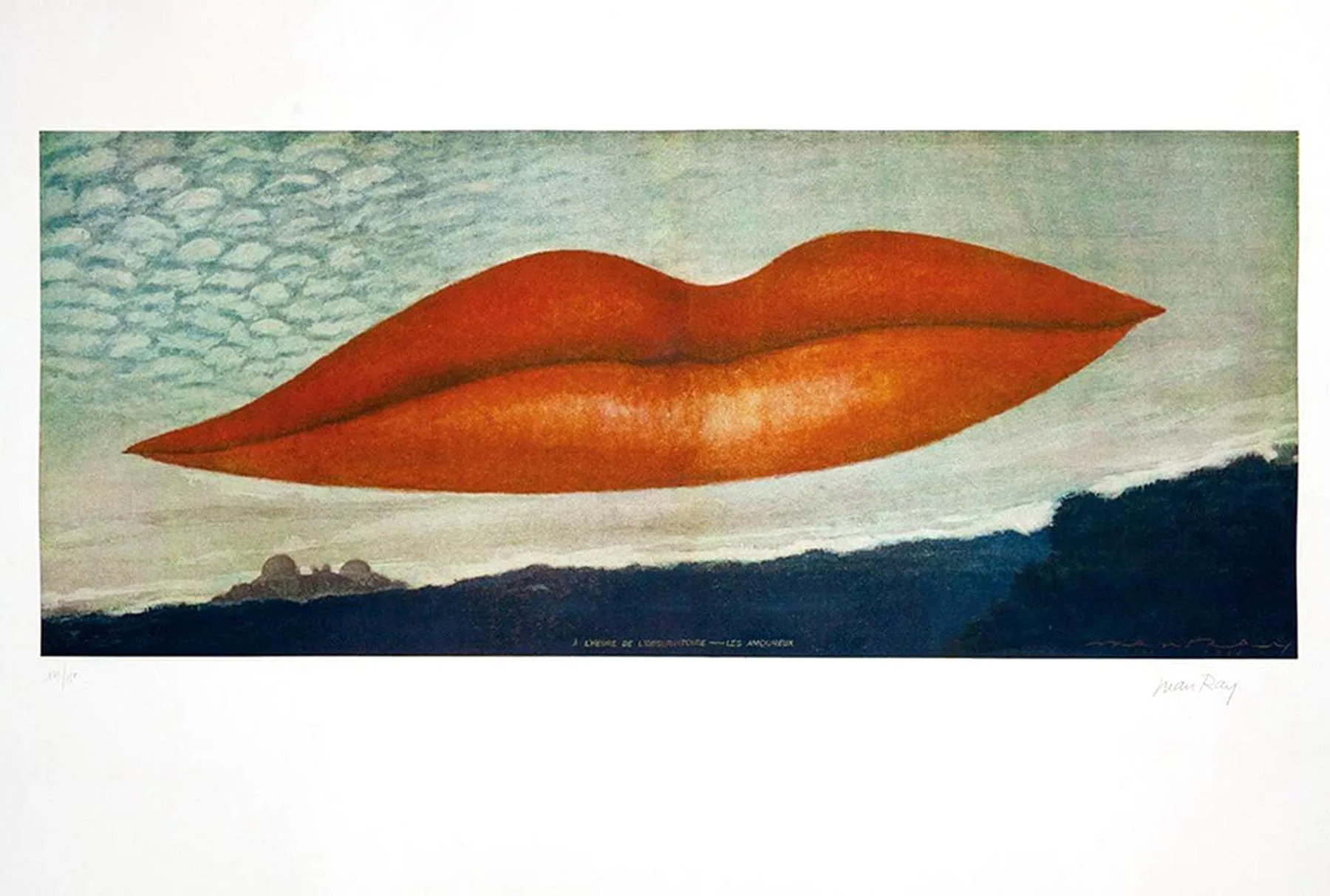
He never abandoned his painting practice. This is evidenced by the paintings exhibited—particularly from the 1930s onwards—at major Surrealist exhibitions; among them is the celebrated À l’Heure de l’Observatoire, les Amoureux (1932–1934), in which Lee Miller’s crimson lips float as giant forms in the sky above the Paris Observatory—a work where the anguish of separation is transformed into a cosmic vision.
Alongside his painting, he continued his graphic work, driven by a desire to disseminate his art as widely as possible, bypassing concepts of uniqueness and originality—notions that seemed to lose their significance for Man Ray. This issue has regained urgency today, in an era when technology is challenging our understanding of what constitutes an artwork and who its creator is: Rayographs were photographs made without a camera, and the artist would replicate his own subjects decades later without perceiving any loss of quality.
“Objects of affection”—ready-mades transformed by the artist’s intervention—powerfully embody this attitude. Cadeau (Gift)—a flatiron with nails attached to its underside—was created on December 3, 1921, the opening day of Man Ray’s first solo exhibition in Paris at Philippe Soupault’s Librairie Six; although the original was stolen that very day, the artist would go on to replicate it numerous times starting in 1963. Similarly, Indestructible Object (1931)—a metronome featuring an image of Lee Miller’s eye, which was later renamed Object to Be Destroyed following the end of his relationship with the photographer—was conceived with the idea that it could be replicated, manipulated, and reinterpreted depending on the occasion.
The fusion of painting and design is also evident in works such as Palettable—a palette-shaped table conceived in 1941 and later produced in 1971—and the 1955 Monument to the Unknown Painter. One of the most relevant artists of the 20th century, he was elevated to iconic status by Andy Warhol; the two maintained a relationship in Warhol’s later years, with the younger artist effectively carrying forward the premises of Man Ray’s work within the context of post-war America.
The exhibition also documents pivotal moments in the history of the avant-garde: Résurrection des Mannequins (Resurrection of the Mannequins) captures one of the most fascinating rooms from the 1938 International Surrealist Exhibition at the Galerie Beaux-Arts in Paris. There, artists including Dalí, Ernst, Miró, Duchamp, and Man Ray himself decorated female mannequins as part of an installation that remains one of the most legendary of the 20th century. Also featured are rare yet significant cinematic works—films that have become landmarks in the history of avant-garde cinema. These constitute a distinct chapter of the artist’s creative output, yet remain inseparable from his overarching vision, which conceived of art as a total life experience, free from disciplinary, stylistic, or thematic boundaries.
Special attention is paid to the intense relationship between Man Ray and Italy, particularly during the 1960s and 1970s.
The exhibition draws on loans from major museums, renowned galleries, and private collections in Italy and abroad, and is curated by Walter Guadagnini, Mauro Carrera, and Stefano Roffi. With Man Ray: Tutto, the Villa dei Capolavori—which has previously hosted major exhibitions on figures who shared the avant-garde stage with Man Ray (such as Miró, de Chirico, Cocteau, Warhol, and Munari)—brings these various paths together in the figure of the artist who traversed them all more than any other.
A comprehensive catalogue, published by Dario Cimorelli Editore, features all the exhibited works alongside essays by the curators and distinguished scholars, including Paolo Albani, Silvana Annicchiarico, Andrea Bellavita, Eva Brioschi, Alice Ensabella, Flaminio Gualdoni, Marco Meneguzzo, Alessandro Nigro, and Giangavino Pazzola.